![Biological Influence on Future Ocean Storage of Carbon [logo]](/themes/biocarbon-NOC8X/logo.svg)
Recognising the value of further integration of the Autosub Long Range (ALR) dataset collected by the BIO-Carbon-FMRI mission with other autonomous platforms and shipboard data collected during the BIO-Carbon fieldwork, BIO-Carbon PIs were successful in winning additional funding from NERC to carry out additional analyses to enhance delivery of the fieldwork component. The project ran from September 2025-March 2026.
There is huge potential in combining the ALR data with that of gliders, floats and ship data to generate merged datasets that cover larger spatial and temporal scales than is possible with one data source alone. These datasets would be invaluable for obtaining a seasonal, basin-wide view on key parameters and processes, and for model development and validation in BIO-Carbon Phase 2 projects.
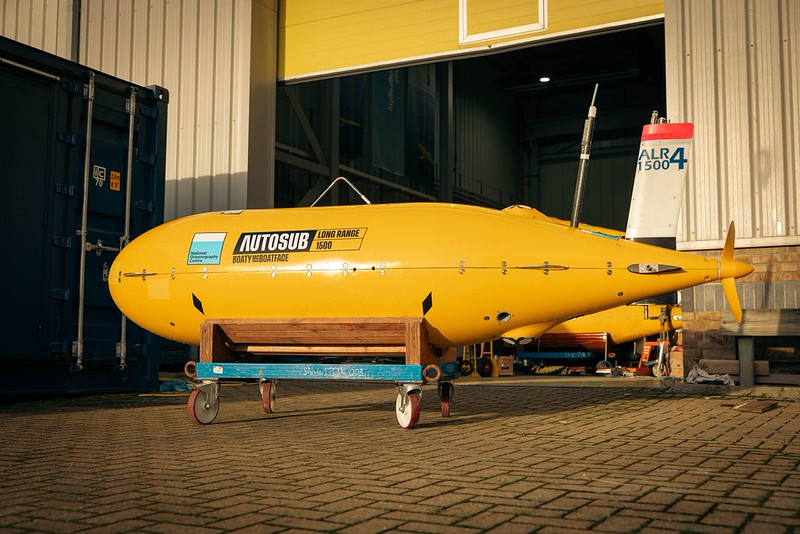
Image Copyright: National Oceanography Centre
NERC provided funding to support 4 tasks:
1) combining ALR and ship carbonate chemistry to assess air-sea CO2 fluxes;
2) combining ship, float and ALR imagery data to generate plankton community structure information;
3) generating a merged particle size distribution dataset, crossing platforms (ship, ALR, float) and imaging systems (UVP, LisstHolo, WeeHoloCam);
4) generating cross-platform (ship, ALR, glider, float) estimates of primary production from bio-optical sensors and hyperspectral PAR.
Four task teams were set up to deliver each of the elements of the project. The “sprint” format allowed focused effort on developing the necessary data processing pipelines and associated skills in the team.
If you have any questions please contact Pablo Trucco-Pignata (Task 1), Amanda Elineau (Task 2), Aaron Ferderer (Task 3) or Flavien Petit (Task 4).