![Biological Influence on Future Ocean Storage of Carbon [logo]](/themes/biocarbon-NOC8X/logo.svg)
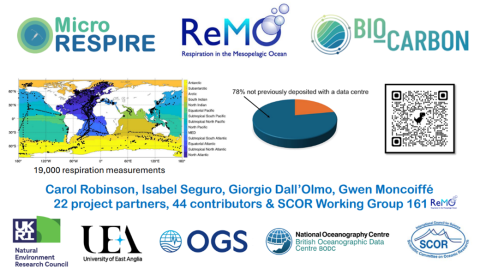
A major new dataset bringing together measurements of marine microbial respiration from across the global ocean is now available to scientists investigating how marine life helps store carbon in the ocean. https://www.bodc.ac.uk/data/published_data_library/catalogue/10.5285/4b…
Collated through the UK research project MicroRESPIRE and the international Respiration in the Mesopelagic Ocean (ReMO) working group, the compilation represents one of the most comprehensive efforts to date to synthesise respiration measurements in the ocean’s mesopelagic zone (the “twilight zone”) between 200 and 1,000 metres depth.
The work was supported by the UK Natural Environment Research Council (NERC) through the BIO-Carbon programme and by the Scientific Committee on Oceanic Research (SCOR), including funding from the U.S. National Science Foundation.
Why Microbial Respiration Matters
Marine microbes play a central role in the global carbon cycle. As organic matter sinks from the sunlit surface ocean, microbes break it down and respire it, transforming organic carbon back into carbon dioxide. The balance between production at the surface and respiration at depth determines how much carbon is stored in the ocean interior and for how long.
Yet respiration in the mesopelagic remains one of the least constrained components of the ocean carbon budget. By assembling diverse measurements into a single, harmonised resource, this dataset provides a powerful tool for both field scientists and modellers working to close that gap.