![Biological Influence on Future Ocean Storage of Carbon [logo]](/themes/biocarbon-NOC8X/logo.svg)
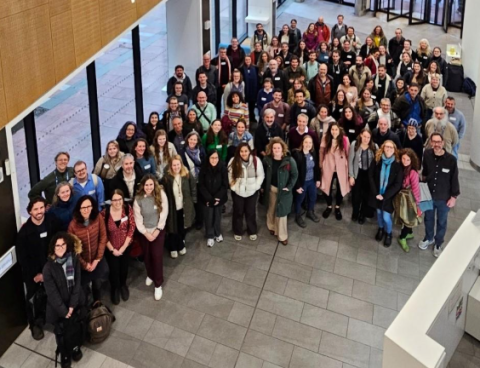
Scientists from around the world gathered in the Technology and Innovation Centre at the University of Strathclyde from 2–4 March for a major international workshop led by the NERC BIO-Carbon programme. The event brought together 103 in-person participants and around 70 online attendees, spanning modelling, observational, and experimental research communities.
Marine organisms play a vital role in helping the ocean store carbon, yet current climate models struggle to consistently predict how this capacity may change in the future. The workshop addressed this challenge by pooling global expertise and data to identify the most critical biological and biogeochemical processes that need to be better represented in next-generation models.
Participants worked across 10 key themes, addressing how marine life affects the ability of the ocean to take up carbon dioxide, how they turn that carbon dioxide into living material and how that eventually breaks down back into carbon dioxide. Each theme identified the top three processes or characteristics that should be incorporated into global biogeochemical models, as well as a single highest priority. These outputs will form the basis of a planned publication summarising the workshop’s findings. The EU OceanICU project have also kindly offered to put together a concise briefing for policy-makers and funders based on the workshop outcomes. A central aim of the meeting was to foster collaboration across disciplines, enabling scientists to co-design practical roadmaps for integrating complex biological processes into climate models.
By bridging gaps between data, experiments, and modelling approaches, the workshop marks an important step towards improving predictions of the ocean’s role in global carbon cycling.
The workshop was organised with support from the Marine Alliance for Science and Technology for Scotland (MASTS - https://masts.ac.uk/research/biogeochemistry-forum/) and its Marine Biogeochemistry Forum and from NASA. It included contributions from leading international projects such as APERO (France), BIOPOLE (UK), EXPORTS (USA), JETZON, OceanICU (EU), PICCOLO (UK), REMO (SCOR), SOLACE (Australia), and TCA (Canada).